Brain injury in HIE can continue to evolve after oxygen and blood flow are restored.

1

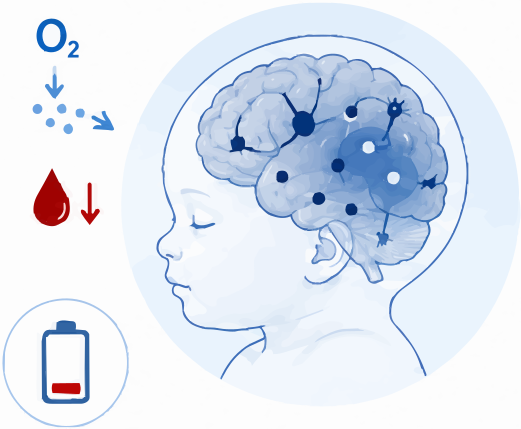
Reduced Oxygen
& Blood Flow

Initial injury
Illustration showing reduced oxygen and blood flow affecting a baby's brain

Brain cells lose the energy
they need to function.

2

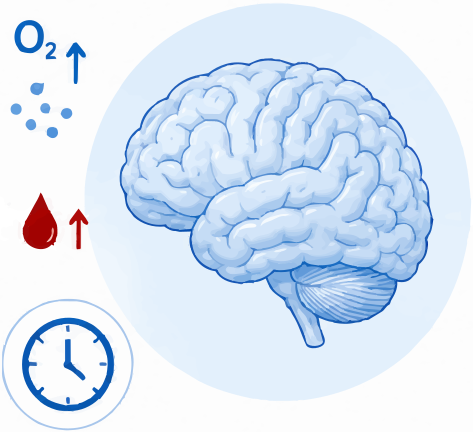
Brief Recovery Window

After circulation returns
Illustration showing oxygen and blood flow returning to the brain

The brain may briefly
appear to recover.

3

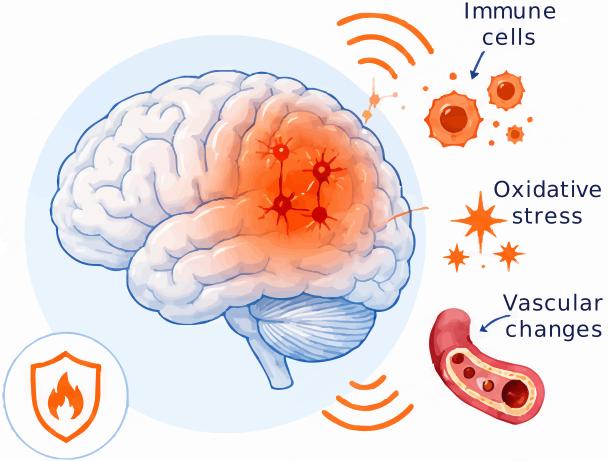
Secondary Injury &
Inflammation

Hours to days
Illustration showing inflammation, oxidative stress, immune activity, and vascular changes in the brain

Inflammation, oxidative stress,
and vascular changes can
extend injury.

What Happens in the Brain?

When the brain does not receive enough oxygen and blood, brain cells lose the energy they need to function. After circulation is restored, the brain may briefly appear to recover. However, additional injury can develop over the following hours and days.

What is the role of inflammation in HIE?

Inflammation is the body’s natural response to injury, designed to protect and repair damaged tissue. In HIE, however, this response can become excessive and contribute to further brain injury.

After the initial loss of oxygen and blood flow, the brain enters a secondary phase of injury driven in part by inflammation. During this phase, immune signals, oxidative stress, and vascular changes can extend damage beyond the original injury site.

Because several inflammatory processes occur simultaneously, researchers are exploring therapies that can target multiple pathways involved in brain injury progression.

For more detailed information, including published research papers on these topics, please see below:

References:

  1. Acun et al. Trends of neonatal hypoxic-ischemic encephalopathy prevalence and associated risk factors in the United States, 2010 to 2018. American Journal of Obstetrics and Gynecology, 2022. Ahearne et al. Short and long term prognosis in perinatal asphyxia. Archives of Disease in Childhood.
  2. American Academy of Pediatrics. Therapeutic hypothermia for neonatal hypoxic-ischemic encephalopathy. Pediatrics.
  3. Armour et al. Neonatal Hypoxic Ischemic Encephalopathy: An Updated Preclinical and Clinical Review. OBM Neurobiology, 2020.
  4. Azzopardi et al. Moderate hypothermia to treat perinatal asphyxial encephalopathy. New England Journal of Medicine, 2009.
  5. Babbo et al. Neonatal encephalopathy due to suspected hypoxic ischemic encephalopathy: pathophysiology and emerging treatments. World Journal of Pediatrics, 2024.
  6. Bitar et al. Multi-organ dysfunction across the neonatal encephalopathy spectrum. Pediatric Research, 2025.
  7. Chen et al. Targeting Myeloperoxidase (MPO) Mediated Oxidative Stress and Inflammation for Reducing Brain Ischemia Injury: Potential Application of Natural Compounds. Frontiers in Physiology, 2020.
  8. Centers for Disease Control and Prevention. Births: Final Data for 2023. National Vital Statistics Reports, 2025.
  9. Centers for Disease Control and Prevention. Developmental disabilities and early intervention.
  10. Chakkarapani et al. Neonatal encephalopathy and hypoxic-ischemic encephalopathy: the state of the art. Pediatric Research, 2025.
  11. Cornet et al. Perinatal Hypoxic-Ischemic Encephalopathy: Incidence over Time Within a Modern US Birth Cohort. Pediatric Neurology, 2023.
  12. Davidson et al. Therapeutic hypothermia for neonatal hypoxic-ischemic encephalopathy. Journal of Neurochemistry, 2015.
  13. Fatemi and Wilson. Oxidative stress and neonatal brain injury. Developmental Neuroscience.
  14. Glass et al. Contemporary profile of seizures in neonates. JAMA Neurology.
  15. Hou and Zhang. Microglial response in hypoxic-ischemic brain injury. Frontiers in Immunology,
  16. Huntingford et al. Long-term outcomes following hypoxic-ischemic encephalopathy. Clinics in Perinatology, 2024. Jacobs et al. Cooling for newborns with hypoxic ischaemic encephalopathy. Cochrane Database of Systematic Reviews, 2013.
  17. Jiang et al. Oxidative stress in neonatal hypoxic-ischemic encephalopathy. Frontiers in Molecular Neuroscience, 2019.
  18. Johnston. Plasticity in the developing brain. Brain and Development.
  19. Kichev et al. Neutrophil extracellular traps in neonatal HIE. International Journal of Molecular Sciences, 2023.
  20. Kumar et al. Complement inhibition reduces brain injury in HIE models. PLOS ONE, 2021.
  21. Lempinen et al. Blood-brain barrier disruption following neonatal hypoxia-ischemia. Cells, 2024.
  22. Liu et al. Inflammatory responses in hypoxic ischemic encephalopathy. Acta Pharmacologica Sinica, 2014.
  23. Marlow et al. Neurologic and developmental disability at 6 to 7 years after hypothermia treatment. New England Journal of Medicine, 2014.
  24. National Institute of Neurological Disorders and Stroke. Hypoxic Ischemic Encephalopathy.
  25. Novak et al. Early, accurate diagnosis and early intervention in cerebral palsy. JAMA Pediatrics,
  26. Pihl et al. Complement system in neonatal brain injury. Frontiers in Immunology, 2019.
  27. Ravichandran et al. Incidence, Intrapartum Risk Factors, and Prognosis of Neonatal Hypoxic- Ischemic Encephalopathy Among Infants Born at 35 Weeks Gestation or More. Journal of Obstetrics and Gynaecology Canada, 2020.
  28. Shankaran et al. Whole-body hypothermia for neonates with hypoxic-ischemic encephalopathy. New England Journal of Medicine, 2005.
  29. Tan et al. Analysis of global, regional, and national burdens of neonatal encephalopathy from 1990 to 2021: insights from the Global Burden of Disease Study 2021. Frontiers in Public Health,
  30. Volpe. Neurology of the Newborn.
  31. Yao and Kuan. Neutrophil infiltration in neonatal hypoxic-ischemic brain injury. Journal of Cerebral Blood Flow and Metabolism, 2019.
  32. Zanelli, et al. Therapeutic Hypothermia for Neonatal Hypoxic-Ischemic Encephalopathy: Clinical Report. Pediatrics, 2026.